

The Carthaginians control the entire southern part of the western Mediterranean while the Celts besiege the Greek cities as well as Rome. The supplies of tin and amber become uncertain and this is a significant loss of income for Massalia. An ambassador must be sent.
* The Geopolitical Context.
Marseille was born in the 6th century BC, about 300 years before Pytheas. The Greeks founded Massalia, which quickly became prosperous. It was based on the control of trade in the northwestern part of the Mediterranean. To the east of Marseille, the Greeks founded the cities of Olbia (Hyères), Antipolis (Antibes) and Nikaia (Nice). On the narrow coastal strip, the Greeks planted vines, and fruit production was also important.
The Massaliotes also ventured westward; first it was the city of Agde, of great strategic importance because it was at the mouth of the Aude, and further on the Garonne, oneof the tin routes. But the riches of Iberia were also coveted. We had to go further. There is Amporion "2 days and 1 night of sailing" (Ampurias, at the beginning of the Costa Brava), created about 40 years after Massalia; then, further down, next to the mouth of the Rio Segura, south of Alicante, the fortified trading post of Santa Pola. This very important trading post gives access to the mineral wealth of Tartessos and the Siérra Morena (copper used in the composition of bronze and silver for jewelry and coins). Another trading post, that of Mainaké, close to present-day Malaga, offers the same advantages as the previous one. Thus the Massaliotes can trade with Iberia under the noses of the Carthaginians who control the southwest of the Mediterranean, via Cadiz.
Carthage, recently liberated from its mother city Tyre, develops very quickly. Ideally located on the strait between Africa and Sicily, it controlled the passage between the east and west of the Mediterranean, from the south, while the Greeks controlled the narrow passage between Sicily and Italy, the Strait of Messina. The Carthaginians, to establish this control, joined forces with the Etruscans and created trading posts in Sicily, which triggered hostilities with the Greeks
 |
The occupation of the western Mediterranean at the time of Pytheas |
Gadir (Cadiz), ideally located at the mouth of the Quadalquivir, gives Carthage maritime control of the mines of southern Spain. The colony of course controls trade to the west of "Libya" and the west coast of Spain, in particular the tin of Galicia. Carthage also controls the island of Ibiza in the Balearic Islands.
* The Socio-Economic Context.
Examining the distribution of the typical Amphorae of Massalia in the Mediterranean and in Gaul, we find as expected a high concentration on the coast, from Marseille to Nice, as far as Spain. They are also present in the Aude valley, as far as Toulouse, and much more numerous in the Rhone valley, as far as the sources of the Seine and the Rhine valley. These amphorae bear witness to the exchanges between the Massaliote community and the "barbarians". They are used to transport wine which was unknown to the Gauls. There is no doubt that only the aristocracy in the Celtic world can afford this luxury product, and with it, everything that, at the time, is linked to wine: cups, jugs etc, in decorated bronze. Coins are also exchanged, in silver for the Massaliote drachmas, or in gold for the coins from central Greece. Coral also as well as garnets from the Maures massif.
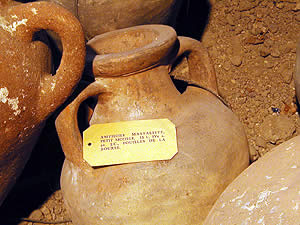 |
Amphores Massaliotes. Musée d’histoire de Marseille |
In return, the people of Marseille received tin that arrived via the Aude, the Garonne and Brittany or via the Loire. The other route was that of the Seine and the Rhône. The extraction site was located in the Cassiterides Islands. But where were the Cassiterides Islands for the Massaliotes? Another product was imported into Lacydon: amber. It arrived from the Baltic Sea via the Rhine Valley, then that of the Rhône. Another route, probably via the Elbe, crossed the centre of Europe, then beyond the Alps, arriving at the mouth of the Po (Eridan). In the middle of the 4th century BC, at the time of Pytheas, the Massaliote economy was very seriously disrupted by migrations and attacks by Gallic barbarians. The most important route, that of the Rhône, had become uncertain, or even cut off. This represents a significant loss of income for the Phocaean city, and an industrial imbalance for the Greek world.